Showing posts with label Social Divisions. Show all posts

Thursday, March 22, 2012

Light Skin vs. Dark Skin

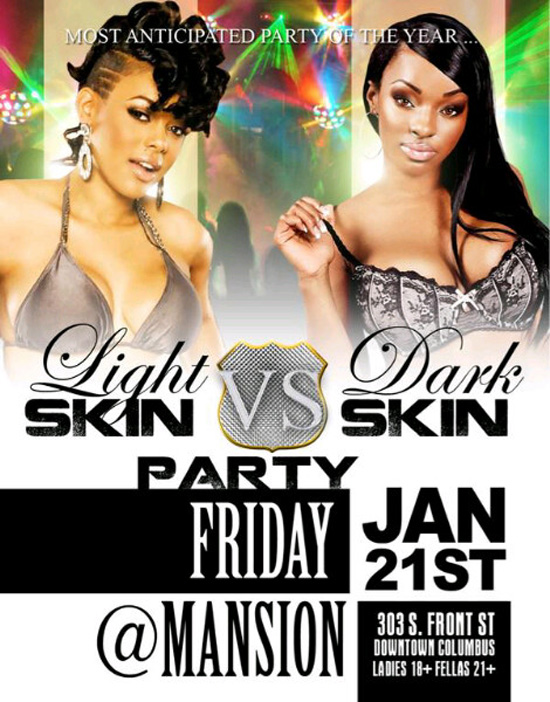
Ohio: Club Promoters decide to take the trending topic to the clubs


Discrimination and privilege isn't manifested between races, but within races as well. Think of your own race, and think of the hierarchies within your race based on skin tone, citizenship, "authenticity"...
You don't have to be black to relate to what I am saying in this post. Competition exists WITHIN races, WITHIN genders, WITHIN any social marker. But blackness is used as an example due to the recent events mentioned.....

If you're on Twitter, you've heard of the hashtag/trending topic #TeamLightSkinned and #TeamDarkSkinned. Although Twitter is known for its humourous trending topics, there is a far more cultural, political and historical context to the skin tones of the black community that makes it offensive. It is worse when this is taken beyond Twitter, and into the real lives of real black people.

Behind the anonymity of Twitter and other social networking sites, people will tweet anything, without the fear of getting caught, without personal responsibility and without the concern that their tweets reflect on their own self-worth.

Aside from the controversy from the event pictured above in Ohio, there was another one last month:


Black women labelled light or dark skinned were put into competition. How is this judged exactly? ... Are black women who are light seen as more attractive so they may win the competition? How black women who are dark skinned seen as more "authentic" so that is their chance?
How do you even bring yourself to rate black women based on their skin tones. Do black women not have more value than this?--- Where is the respect?

How you define your identity is not just through how you view yourself. It is a reflection of others, practices, institutions etc. If you are black and you took part in this trending topic on Twitter, how do you identify your blackness?

During the slavery days, "mullattos" were given more privileges for having a skin one "closer" to Whites. Perhaps slavery is over... but isn't it clear that racial privilege a race still exists?

Wednesday, March 21, 2012

Jay Smooth: "Who are you?" "What are you?"


Have you ever been asked, "WHAT ARE YOU?" as a conversation starter on your identity? 
Jay Smooth ( real name John Randolph) is the founder of New York's hip hop program Underground Railroad. He addresses the conflicts of his identity of a "mixed race" and how this, in turn, impacted his life. He shares his story about what it is like to grow up with this type of identity--- yet I think we can all somewhat identify with "WHAT ARE YOU?" type of questions, even if we aren't of a mixed race.


Jay Smooth- How I Learned to Stop Worrying
and Love Discussing Race


Jay Smooth- How To Tell People They
Sound Racist


You can see Smooth's video blog site here

Enjoy :)

Thursday, October 27, 2011

Peggy McIntosh: Unpacking the Invisible Knapsack

Peggy McIntosh

In relation to my last blog post on B. Deutsch's Male Privilege Checklist, there is also the famous Peggy McIntosh and her list. She has what is called an "Invisible Knapsack". What is in this knapsack?: WHITE PRIVILEGES. McIntosh explores the idea of having this knapsack of privileges wherever she goes. She assures you that it's invisible... but it's there.

Have a read:

1. I can if I wish arrange to be in the company of people of my race most of the time.
2. I can avoid spending time with people whom I was trained to mistrust and who have learned to mistrust my kind or me.
3. If I should need to move, I can be pretty sure of renting or purchasing housing in an area which I can afford and in which I would want to live.
4. I can be pretty sure that my neighbors in such a location will be neutral or pleasant to me.
5. I can go shopping alone most of the time, pretty well assured that I will not be followed or harassed.
6. I can turn on the television or open to the front page of the paper and see people of my race widely represented.
7. When I am told about our national heritage or about "civilization," I am shown that people of my color made it what it is.
8. I can be sure that my children will be given curricular materials that testify to the existence of their race.
9. If I want to, I can be pretty sure of finding a publisher for this piece on white privilege.
10. I can be pretty sure of having my voice heard in a group in which I am the only member of my race.
11. I can be casual about whether or not to listen to another person's voice in a group in which s/he is the only member of his/her race.
12. I can go into a music shop and count on finding the music of my race represented, into a supermarket and find the staple foods which fit with my cultural traditions, into a hairdresser's shop and find someone who can cut my hair.
13. Whether I use checks, credit cards or cash, I can count on my skin color not to work against the appearance of financial reliability.
14. I can arrange to protect my children most of the time from people who might not like them.
15. I do not have to educate my children to be aware of systemic racism for their own daily physical protection.
16. I can be pretty sure that my children's teachers and employers will tolerate them if they fit school and workplace norms; my chief worries about them do not concern others' attitudes toward their race.
17. I can talk with my mouth full and not have people put this down to my color.
18. I can swear, or dress in second hand clothes, or not answer letters, without having people attribute these choices to the bad morals, the poverty or the illiteracy of my race.
19. I can speak in public to a powerful male group without putting my race on trial.
20. I can do well in a challenging situation without being called a credit to my race.
21. I am never asked to speak for all the people of my racial group.
22. I can remain oblivious of the language and customs of persons of color who constitute the world's majority without feeling in my culture any penalty for such oblivion.
23. I can criticize our government and talk about how much I fear its policies and behavior without being seen as a cultural outsider.
24. I can be pretty sure that if I ask to talk to the "person in charge", I will be facing a person of my race.
25. If a traffic cop pulls me over or if the IRS audits my tax return, I can be sure I haven't been singled out because of my race.
26. I can easily buy posters, post-cards, picture books, greeting cards, dolls, toys and children's magazines featuring people of my race.
27. I can go home from most meetings of organizations I belong to feeling somewhat tied in, rather than isolated, out-of-place, outnumbered, unheard, held at a distance or feared.
28. I can be pretty sure that an argument with a colleague of another race is more likely to jeopardize her/his chances for advancement than to jeopardize mine.
29. I can be pretty sure that if I argue for the promotion of a person of another race, or a program centering on race, this is not likely to cost me heavily within my present setting, even if my colleagues disagree with me.
30. If I declare there is a racial issue at hand, or there isn't a racial issue at hand, my race will lend me more credibility for either position than a person of color will have.
31. I can choose to ignore developments in minority writing and minority activist programs, or disparage them, or learn from them, but in any case, I can find ways to be more or less protected from negative consequences of any of these choices.
32. My culture gives me little fear about ignoring the perspectives and powers of people of other races.
33. I am not made acutely aware that my shape, bearing or body odor will be taken as a reflection on my race.
34. I can worry about racism without being seen as self-interested or self-seeking.
35. I can take a job with an affirmative action employer without having my co-workers on the job suspect that I got it because of my race.
36. If my day, week or year is going badly, I need not ask of each negative episode or situation whether it had racial overtones.
37. I can be pretty sure of finding people who would be willing to talk with me and advise me about my next steps, professionally.
38. I can think over many options, social, political, imaginative or professional, without asking whether a person of my race would be accepted or allowed to do what I want to do.
39. I can be late to a meeting without having the lateness reflect on my race.
40. I can choose public accommodation without fearing that people of my race cannot get in or will be mistreated in the places I have chosen.
41. I can be sure that if I need legal or medical help, my race will not work against me.
42. I can arrange my activities so that I will never have to experience feelings of rejection owing to my race.
43. If I have low credibility as a leader I can be sure that my race is not the problem.
44. I can easily find academic courses and institutions which give attention only to people of my race.
45. I can expect figurative language and imagery in all of the arts to testify to experiences of my race.
46. I can chose blemish cover or bandages in "flesh" color and have them more or less match my skin.
47. I can travel alone or with my spouse without expecting embarrassment or hostility in those who deal with us.
48. I have no difficulty finding neighborhoods where people approve of our household.
49. My children are given texts and classes which implicitly support our kind of family unit and do not turn them against my choice of domestic partnership.
50. I will feel welcomed and "normal" in the usual walks of public life, institutional and social.


-------
Pretty strong stuff.

B. Deutsch: Male Privilege Checklist

There are some of us that have a privilege in some aspect of our lives and don't even know it. Without going to look for power, we don't realized that we have it. Although I am East Asian and a woman (and I can be oppressed within and across gender in comparison to a man, and racially with white men and women) I hold privileges too
Economically: I grew up privileged. I've been working since I was 14, but having family money put me at ease. I had a back-up plan if anything were to happen... emergency money was a phone call away.
Abilities: I'm able bodied. I can walk, speak, have basic motor skills to button up my shirt. I don't have to look for limited parking spaces that are reserved for people like me, yet, people who don't need them take them anyway. I can enter establishments with or without ramps, automatic doors and elevators big enough for my wheelchair. I hold privileges as an able-bodied individual.
Sexuality: Having never questioned my own heterosexuality, I hold privileges of being straight. I can publicly display affection for my significant other without concern that I am being watched, judged and the basis for a joke.
...
Without looking for power in these areas, I just have them. And these powers and privileges I possess cannot be forfeited just because I am oppressed by gender and race. Powers are not exchangeable. 
Below is B. Deutsch's Male Privilege Checklist that was posted on Black Coffee Poet's Blog (by Jorge Vallejos).


I appreciate that it doesn't just address issues of wage gaps and violence when discussing gender studies. It addresses privileges men have various levels of the social world.
Here it is: 
1. If I’m a teen or adult, and if I can stay out of prison, my odds of being raped are so low as to be negligible.
2. I am not taught to fear walking alone after dark in average public spaces.
3. Chances are my elected representatives are mostly people of my own sex. The more prestigious and powerful the elected position, the more likely this is to be true.
4. I can be somewhat sure that if I ask to see “the person in charge,” I will face a person of my own sex. The higher-up in the organization the person is, the surer I can be.
5. If I’m careless with my driving it won’t be attributed to my sex.
6. If I have sex with a lot of people, it won’t make me an object of contempt or derision.
7. I can ask for legal protection from violence that happens mostly to men without being seen as a selfish special interest, since that kind of violence is called “crime” and is a general social concern. (Violence that happens mostly to women is usually called “domestic violence” or “acquaintance rape,” and is seen as a special interest issue.)
8. Every major religion in the world is led primarily by people of my own sex. Even God, in most major religions, is usually pictured as being male.
9. Magazines, billboards, television, movies, pornography, and virtually all of media is filled with images of scantily-clad women intended to appeal to me sexually. Such images of men exist, but are much rarer.
10. If I am heterosexual, it’s incredibly unlikely that I’ll ever be beaten up by a spouse or lover.